
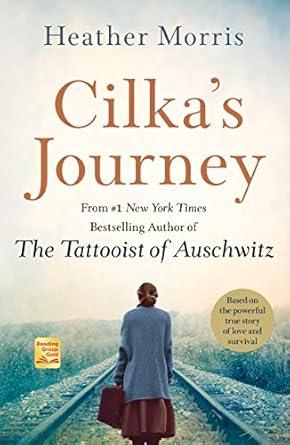
In Morris’s follow-up novel of the The Tattoosist of Auschwitz she makes it clear that while the story is based on actual events in Cecília Kováčová ‘Cilka Klein’ life, it still a novel of fiction weaving together facts and reportage with experiences of women survivors of the Holocaust and the experiences of women sent to Soviet Gulag system in Siberia at the end of World War II. Morris expresses that her novel does not represent all the facts of Cilka’s life and contains a mix of characters inspired by real-life figures and others completely imagined. It is essential to note that the controversy surrounding her first book continues with this one, as Kováčová’s stepson reported that he found Morris’s telling to be both lurid and titillating, hurtful and appalling to the memory of his stepmother.
The book is available on Amazon in paperback, hardcover, Kindle, and audiobook formats, as well as at your local library through the Libby App. The audiobook, published on October 1, 2019, is narrated by Louise Brealey, who maintains a tone as emotionless as the writing. Morris’s telling of Cilka’s Journey is cold and detached, once again failing to connect her audience to the characters and drawing on the powerful emotions this story should evoke, as her writing style is bereft of emotional depth. It is fact-based, with a journalism-style approach that draws out bullet points, and the atrocities are overlooked through the use of pink-colored glasses, as if addressing a younger audience and trying not to offend.
In 1942, sixteen-year-old Cecilia Klein is taken by force to Auschwitz-Birkenau. Her beauty captivates two high-ranking SS Commandants, who make her their sex slave. Sexually abused repeatedly and forced to work on the death block watching women, even her own mother, before they are brought to the gas chambers, Cilka does all she can to survive in this horrid place. She’s eighteen when the camps are liberated, and although she hopes they’ll understand she did what she did to avoid death and let her go home to Czechoslovakia, they charge her as a collaborator for sleeping with the enemy and condemn her to a fifteen-year sentence in a prison camp in Siberia. After losing everything and enduring so much, she’s being punished for it and ends up in another place where power is vital for survival. In the new prison, she suffers more sexual abuse, and wonders the point of going on, at times, despair overwhelms her, but there’s a flame inside her helping to keep going.
Cilka’s skills and capacity for languages impress one of the camp’s female doctors, who offers Cilka a job in the hospital. This comes with advantages but may cause jealousy among the other women in her hut. Although Cilka tries to make friends, she doesn’t reveal anything about herself; instead, she carries the shame of what went on in that other place, reliving it in her nightmares. She worries that if others find out what she did there, they would hate her, so she tries to get through each day with the same two choices as before: survival or death. Through it all, she endures, even falls in love with a fellow prisoner, although this storyline is poorly developed and quite unbelievable.
Morris’s attempt at a deeply emotional story about survival, resilience, hope, and an unbroken human spirit in the harshest of times falls far from the mark. There are zero emotions in her writing connecting her readers or listeners to the characters, making it impossible for the audience to understand how someone survived the camps’ brutal conditions, cold, hunger, repeated rapes, and abuse, the terror coursing through her when men invaded the hut night after night, when other inmates issued threats after threats. Where’s the author’s thought-provoking, emotion-gripping account, not a reporter’s telling, of these events? This missing piece is what makes this a 2.5-star read or listen.



















 ROXANNA CROSS

Leave a comment